Protecting DIAS Dunsink Observatory – Safeguarding Ireland’s Scientific Heritage for Future Generations
The Royal Observatory, Greenwich, occupies a commanding position in a historic parkland setting overlooking the River Thames, close to the heart of London. Welcoming almost one million visitors each year, it is one of the world’s most significant historic astronomical observatories and a powerful testament to the enduring relationship between scientific discovery, national heritage and public engagement.
Founded by King Charles II in 1675, Greenwich played a pivotal role in advancing astronomy, improving maritime navigation and establishing an accurate time service for the United Kingdom. Today, it is undergoing a major £77 million refurbishment to improve public access and enhance the visitor experience. Among the historic instruments receiving attention is the Great Equatorial Telescope, manufactured in the late 1880s by the Grubb Telescope Company of Rathmines, Dublin.
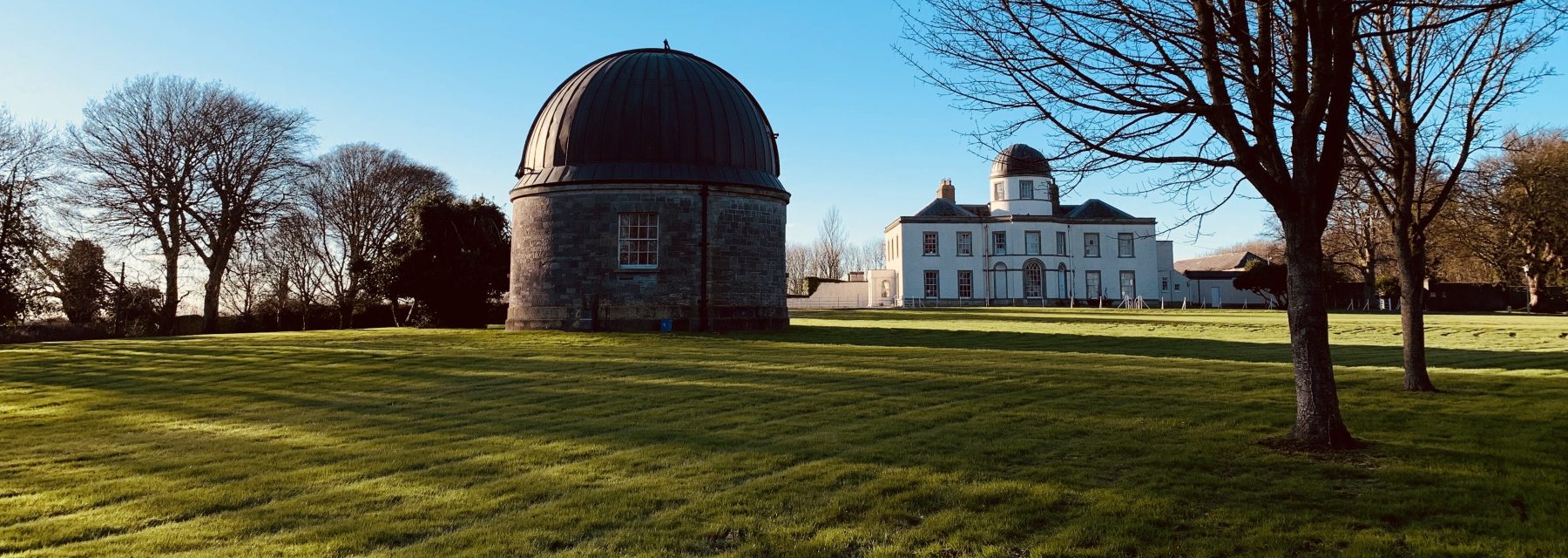
In Ireland, Dunsink Observatory was founded in 1785 by Trinity College Dublin and subsequently became the official observatory of the Royal Astronomer of Ireland under King George III. For more than two centuries, Dunsink has been at the forefront of Irish astronomical research while maintaining a proud tradition of opening its doors and historic telescope domes to the public. Its contribution extends far beyond scientific research: Dunsink is a place where generations of people have encountered the night sky, discovered the wonders of astronomy and connected with Ireland’s scientific past.
Dunsink also played a fundamental role in establishing and maintaining Ireland’s system of civil time. Astronomers measured the precise transit of stars across the Dunsink Meridian, providing an authoritative time service to institutions including Dublin Port, the Central Bank, the General Post Office and Trinity College Dublin. Dublin Mean Time was Ireland’s official legal time standard from 1880 until 1916, running 25 minutes and 21 seconds behind Greenwich Mean Time. This history places Dunsink at the centre of Ireland’s scientific infrastructure and the development of modern public life.
The observatory is also home to a beautifully preserved refracting telescope manufactured by the Grubb company in Rathmines during the 1860s. Designed to measure the positions of stars with precision, this historic instrument has served a wider purpose across the generations. Through its eyepiece, visitors have witnessed celestial wonders ranging from Halley’s Comet and the moons of Jupiter to the immense sunspots that occasionally mark the surface of our nearest star.
Yet Dunsink’s international reputation rests on more than its telescopes. It is inseparable from the legacy of Sir William Rowan Hamilton, one of Ireland’s greatest mathematicians and physicists, who lived and worked at the observatory. Hamilton made foundational contributions to the mathematical description of motion through Hamiltonian dynamics, to the understanding of light through his work on conical refraction, and to three-dimensional mathematics through his invention of quaternions. His ideas continue to influence mathematics, physics and modern scientific applications around the world. Dunsink is therefore not simply an historic observatory: it is a place of scientific significance, permanently associated with discoveries that transformed our understanding of the physical world.
Recognising the national importance of this heritage, the then Taoiseach, Leo Varadkar TD, launched the Astronomical Observatories of Ireland initiative in 2023, bringing together Dunsink, Armagh and Birr to strengthen collaboration and promote Ireland’s shared astronomical legacy. Subsequently, the Government of Ireland nominated Dunsink and Birr observatories for inclusion on UNESCO’s World Heritage Tentative List. This is fitting recognition of the exceptional scientific, historical and cultural value of Ireland’s astronomical observatories, and of the opportunity to protect and promote this heritage through closer cooperation across the island of Ireland.
Today, however, DIAS Dunsink Observatory faces a significant challenge. Fingal County Council is considering plans for the development of lands surrounding the observatory. We recognise the importance of appropriate development and welcome the potential for the area to evolve. However, development must be planned and delivered in a manner that respects the observatory’s historic character, protects its scientific function and preserves its value as a public and educational resource.
We are therefore calling on Fingal County Councillors to support meaningful, enforceable protections for Dunsink Observatory as part of the planning process. These protections should include: a commitment to amendment of the Urban Area Plan following feedback from UNESCO post the Preliminary Assessment step in the UNESCO designation process; the adoption of sensitive, dark-sky-friendly lightingto minimise light pollution, and appropriate limits on building heightsto preserve important views of the horizon. These are practical and proportionate measures that can help ensure development proceeds without irreversibly compromising the observatory’s heritage or its continued use for astronomy and public engagement.
The consequences of getting this wrong could extend well beyond Dunsink itself. Insensitive development could undermine the integrity of the observatory’s historic setting, threaten the credibility of Ireland’s UNESCO World Heritage aspirations and jeopardise the collaborative initiative linking the astronomical observatories of Armagh, Birr and Dunsink. Protecting Dunsink is therefore not simply a local planning issue; it is a matter of national scientific heritage, cultural identity and international standing.
We have inherited an extraordinary legacy. Founded more than 240 years ago, Dunsink Observatory has advanced scientific knowledge, helped establish Ireland’s timekeeping system, inspired generations of visitors and provided the setting for discoveries of lasting global importance. We have a responsibility to ensure that future generations can continue to experience, study and benefit from this unique place.
Once this heritage is lost, it cannot be recreated. We urge Fingal County Councillors to act decisively to protect Dunsink Observatory and ensure that development around it respects the significance of this irreplaceable part of Ireland’s scientific and cultural inheritance.
Professor Peter Gallagher MRIA, Director of DIAS Dunsink Observatory. 20 October 2026.

Leave a Comment
Last Updated: October 21, 2026 by Peter Gallagher
Protecting DIAS Dunsink Observatory – Safeguarding Ireland’s Scientific Heritage for Future Generations
The Royal Observatory, Greenwich, occupies a commanding position in a historic parkland setting overlooking the River Thames, close to the heart of London. Welcoming almost one million visitors each year, it is one of the world’s most significant historic astronomical observatories and a powerful testament to the enduring relationship between scientific discovery, national heritage and public engagement.
Founded by King Charles II in 1675, Greenwich played a pivotal role in advancing astronomy, improving maritime navigation and establishing an accurate time service for the United Kingdom. Today, it is undergoing a major £77 million refurbishment to improve public access and enhance the visitor experience. Among the historic instruments receiving attention is the Great Equatorial Telescope, manufactured in the late 1880s by the Grubb Telescope Company of Rathmines, Dublin.
In Ireland, Dunsink Observatory was founded in 1785 by Trinity College Dublin and subsequently became the official observatory of the Royal Astronomer of Ireland under King George III. For more than two centuries, Dunsink has been at the forefront of Irish astronomical research while maintaining a proud tradition of opening its doors and historic telescope domes to the public. Its contribution extends far beyond scientific research: Dunsink is a place where generations of people have encountered the night sky, discovered the wonders of astronomy and connected with Ireland’s scientific past.
Dunsink also played a fundamental role in establishing and maintaining Ireland’s system of civil time. Astronomers measured the precise transit of stars across the Dunsink Meridian, providing an authoritative time service to institutions including Dublin Port, the Central Bank, the General Post Office and Trinity College Dublin. Dublin Mean Time was Ireland’s official legal time standard from 1880 until 1916, running 25 minutes and 21 seconds behind Greenwich Mean Time. This history places Dunsink at the centre of Ireland’s scientific infrastructure and the development of modern public life.
The observatory is also home to a beautifully preserved refracting telescope manufactured by the Grubb company in Rathmines during the 1860s. Designed to measure the positions of stars with precision, this historic instrument has served a wider purpose across the generations. Through its eyepiece, visitors have witnessed celestial wonders ranging from Halley’s Comet and the moons of Jupiter to the immense sunspots that occasionally mark the surface of our nearest star.
Yet Dunsink’s international reputation rests on more than its telescopes. It is inseparable from the legacy of Sir William Rowan Hamilton, one of Ireland’s greatest mathematicians and physicists, who lived and worked at the observatory. Hamilton made foundational contributions to the mathematical description of motion through Hamiltonian dynamics, to the understanding of light through his work on conical refraction, and to three-dimensional mathematics through his invention of quaternions. His ideas continue to influence mathematics, physics and modern scientific applications around the world. Dunsink is therefore not simply an historic observatory: it is a place of scientific significance, permanently associated with discoveries that transformed our understanding of the physical world.
Recognising the national importance of this heritage, the then Taoiseach, Leo Varadkar TD, launched the Astronomical Observatories of Ireland initiative in 2023, bringing together Dunsink, Armagh and Birr to strengthen collaboration and promote Ireland’s shared astronomical legacy. Subsequently, the Government of Ireland nominated Dunsink and Birr observatories for inclusion on UNESCO’s World Heritage Tentative List. This is fitting recognition of the exceptional scientific, historical and cultural value of Ireland’s astronomical observatories, and of the opportunity to protect and promote this heritage through closer cooperation across the island of Ireland.
Today, however, DIAS Dunsink Observatory faces a significant challenge. Fingal County Council is considering plans for the development of lands surrounding the observatory. We recognise the importance of appropriate development and welcome the potential for the area to evolve. However, development must be planned and delivered in a manner that respects the observatory’s historic character, protects its scientific function and preserves its value as a public and educational resource.
We are therefore calling on Fingal County Councillors to support meaningful, enforceable protections for Dunsink Observatory as part of the planning process. These protections should include: a commitment to amendment of the Urban Area Plan following feedback from UNESCO post the Preliminary Assessment step in the UNESCO designation process; the adoption of sensitive, dark-sky-friendly lighting to minimise light pollution, and appropriate limits on building heights to preserve important views of the horizon. These are practical and proportionate measures that can help ensure development proceeds without irreversibly compromising the observatory’s heritage or its continued use for astronomy and public engagement.
The consequences of getting this wrong could extend well beyond Dunsink itself. Insensitive development could undermine the integrity of the observatory’s historic setting, threaten the credibility of Ireland’s UNESCO World Heritage aspirations and jeopardise the collaborative initiative linking the astronomical observatories of Armagh, Birr and Dunsink. Protecting Dunsink is therefore not simply a local planning issue; it is a matter of national scientific heritage, cultural identity and international standing.
We have inherited an extraordinary legacy. Founded more than 240 years ago, Dunsink Observatory has advanced scientific knowledge, helped establish Ireland’s timekeeping system, inspired generations of visitors and provided the setting for discoveries of lasting global importance. We have a responsibility to ensure that future generations can continue to experience, study and benefit from this unique place.
Once this heritage is lost, it cannot be recreated. We urge Fingal County Councillors to act decisively to protect Dunsink Observatory and ensure that development around it respects the significance of this irreplaceable part of Ireland’s scientific and cultural inheritance.
Professor Peter Gallagher MRIA, Director of DIAS Dunsink Observatory. 20 October 2026.
Category: Blog Posts Tags: blog posts
Latest News
Events
Check out our upcoming events at dunsink.dias.ie/events.
Follow Us